• Home
  • Blog Posts
    • Mental Health
    • Relationships
    • Spirituality
  • Short Stories
  • About
  • Contact

Poets Prose

Expand your awareness

  • Mental Health
  • Relationships
  • Spirituality

May 7, 2023

Attachment Theory & the 4 Attachment Styles

Attachment styles dictate our behaviour in relationships. Our attachment style is dependent on how well our need for attachment was met in childhood.attachment styles
Attachment theory dictates our need to form close bonds with our caregivers as children. How well this need is met establishes our attachment style, which then affects all our adult relationships moving forward.

I first learned about attachment styles in 11th-grade psychology, as well as in university, but began reading books and learning more about the subject after my first relationship. I had always dated people with an avoidant attachment, which as a fairly anxious disorganized was terrible for me.

Learning your attachment style can allow you to be more conscious of your behaviours and work towards a more secure attachment. It can also let you know what styles you should be wary of dating, as they may further trigger your unhealthy attachment.

In this post, I’ll outline attachment theory and the four attachment styles, secure, anxious, avoidant, and disorganized, and give some recommended books on the topic.

This post is all about attachment styles!


What is Attachment Theory?

Attachment theory was originally developed by John Bowlby, a British psychoanalyst. He sought to understand the distress infants experienced when separated from their caregivers. Through observation, he determined that infants would go to great lengths to be reunited with their caregivers. He speculated that these behaviours may serve an evolutionary function. Infants need their caregivers to survive, they’re entirely unable to provide for themselves, meaning without their caregivers, they would die. These attachment behaviours are a product of natural selection, meant to keep an infant’s caregivers close by to survive.

A child is constantly asking themselves, “Is my attachment figure nearby and attentive? Do I feel safe?” If the answer is yes, the child feels secure to play and explore their environment. If the answer is no, the child begins to feel anxious and may exhibit attachment behaviours such as desperately searching or crying. These behaviours will continue until either the child returns to proximity with the caregiver, or the child becomes worn down in cases of prolonged separation or loss. In this case, the child experiences intense despair or even depression.

A child’s attachment style is dictated by how well these attachment needs are met. Children whose caregivers were mostly responsive in their first year of life end up with a secure attachment. Children whose caregivers were inconsistent or unresponsive to their needs result in an anxious or avoidant attachment style


The Four Attachment Styles

Secure

Secure is the most common of all the attachment styles.

People with this attachment are comfortable openly expressing their emotions. They don’t run in the face of conflict, they address issues head-on. Secures are comfortable relying on their partner and having their partner rely on them. They tend to be open and honest in their connections and value emotional intimacy. People with a secure attachment are comfortable in relationships, but also on their own. They don’t rely on others for validation or approval and have a healthy sense of esteem.


Anxious / Preoccupied

People with anxious attachment are more reliant on their partners to feel okay. They deeply fear abandonment and often worry their partner isn’t as invested in the relationship as they are. The thought of being alone causes a lot of anxiety and they’ll do anything to feel close to their partner. They tend to hold others in a higher regard than themselves and struggle with self-worth. They seek a lot of approval and support from their partner and feel a lot of stress and anxiety when this need goes unmet.


Avoidant / Dismissive

The avoidant type views themselves as independent and self-sufficient. They’re not the type to rely on others or ask for help. They keep their emotional distance and tend not to communicate their feelings. Avoidants also have a high sense of self-esteem and don’t like others to rely on them. They don’t feel they need to be in a relationship to feel complete and don’t seek validation or approval from others.


Disorganized / Fearful-Avoidant

Disorganized is the most complicated and uncommon of attachment styles. It contains aspects of both the anxious and avoidant styles.

People with disorganized attachment display inconsistent behaviours in their relationships. They desire emotional closeness but tend to push it away. They have a hard time trusting others and fear getting hurt. Relationships are both a source of longing and fear, as this attachment style is formed by inconsistent and even untrustworthy attachment figures. People with this style have a hard time regulating their emotions and tend to avoid relationships out of fear.

Disorganized attachment is generally a result of childhood trauma or abuse, but can also be caused later in life by an abusive adult relationship. It occurs when the attachment figure, a source of safety, becomes a source of fear.


Keep in mind not everyone fits perfectly into one category, even those who are secure tend to lean either more anxious or avoidant. If you’re unsure which attachment style you are, you can take the Attachment Style Quiz to find out!


How Your Attachment Style Affects Your Relationships

Our attachment style has a huge impact on our adult relationships. Have you ever noticed all your relationships seem to repeat the same pattern? Maybe you cling on to your partners, afraid to be abandoned and they remain distant and detached, always asking for more space. Maybe you push people away as soon as they get close, afraid to let anyone in. This is your attachment style at play.

Our attachment style also dictates who we’re attracted to. Anxious and avoidant attachments are almost always drawn to each other. Though, without a lot of work on both ends this pairing can often be unhealthy. The avoidant triggers the other’s anxious attachment by being distant, causing the anxious partner to chase after the avoidant. The anxious partner then further pushes the avoidant away, causing a constant cycle of back and forth.

People with a secure attachment, on the other hand, can partner with any attachment style. A secure person helps to stabilize another’s unhealthy attachment because they don’t react in the way the opposing attachment style would. So, rather than running when their partner is being clingy or putting too much expectation on them, the secure partner responds healthily through communication. This calms the anxious partner and makes them feel more secure.

Those with a disorganized attachment are best to date those who are secure, as both anxious and avoidant styles can trigger their attachment wounds. Though, with the desire and determination to heal unhealthy attachment, any styles are capable of having a healthy relationship.


Books On Attachment

This section contains affiliate links, which means I’ll receive a commission if you purchase through my link, at no extra cost to you. Please read the full disclosure for more information.


Attached

By Amir Levine & Rachel Heller

buy here


I’d highly recommend Attached for everyone, but especially those with anxious attachments! It covers the science behind attachment theory and gives helpful advice on how to apply it to your relationships. It also contains relevant activities you can utilize to better understand your attachment.

I read Attached not too long ago and it was incredibly useful in better understanding and overcoming my anxious tendencies. It’s a great starting point in better understanding attachment. The only downside is that it does not cover trauma or disorganized attachment.


Polysecure

By Jessica Fern
polysecurePhoto by Me

buy here


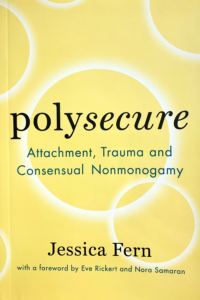
I can’t talk about attachment without mentioning Polysecure. Though Polysecure covers attachment from a non-monogamous viewpoint, its principles can be applied to any relationship style. It gives an in-depth look at each of the attachment styles, including disorganized, covers how trauma impacts our attachment, gives a brief overview of boundaries, and outlines how we can work to be more secure in our relationships. I honestly can’t gush about this book enough, it truly is a must-read when it comes to understanding attachment.


Related Post: What is a Polyamorous Relationship?


The Power of Attachment

By Diane Poole Heller

buy here

The Power of Attachment covers how trauma impacts our attachment style. Dr. Heller, a pioneer in attachment theory and trauma resolution outlines how traumatic experiences affect ourselves, the world around us, and our connections with others. She teaches you how to restore connections lost to trauma, feel whole and embodied in yourself, integrate wounded parts of yourself, emerge from fear or grief, and reclaim your inner nature.


As you can see, our attachment style has a huge effect on how we connect to others and how our relationships play out. Keep in mind, no one is stuck with an unhealthy attachment. Work towards understanding attachment and cultivating healthier behaviours, and you’re sure to be on your way to becoming more secure.


Post by Morgan Peters


Other Posts You May Like:

Shadow Work Prompts & Explanation
What is Ethical Non-Monogamy & Why is It on the Rise?
What is Spirituality & How Does It Differ From Religion?


Sources:

Cherry, Kendra. “How Attachment Theory Works.” Verywell Mind, Verywell Mind, 22 Feb. 2023, https://www.verywellmind.com/what-is-attachment-theory-2795337.

“A Brief Overview of Adult Attachment Theory and Research: R. Chris Fraley.” A Brief Overview of Adult Attachment Theory and Research | R. Chris Fraley, 2018, http://labs.psychology.illinois.edu/~rcfraley/attachment.htm.

“Attachment Styles and Their Role in Adult Relationships.” Attachment Project, 6 Apr. 2023, https://www.attachmentproject.com/blog/four-attachment-styles/.

“Disorganized Attachment Style: Everything You Need to Know.” Attachment Project, 6 Apr. 2023, https://www.attachmentproject.com/blog/disorganized-attachment/.


Posted In: Attachment, Relationships

About Me

About Me
Morgan is a writer and poet. In 2020 she began posting her original poems to Instagram featuring long captions delving deeper into her pieces. Poet's Prose acts as an extension to these insightful write-ups, bulding upon themes of relationships, mental health, and spirituality.

Get Social

Featured Posts

law of detachment definition

The Law of Detachment Definition

Polyamory vs Polygamy vs Polyandry

Polyamory vs Polygamy vs Polyandry: What’s the Difference?

what causes selective mutism

What Causes Selective Mutism? Misconceptions & More!

Browse the Blog

  • Home
  • Blog Posts
  • Short Stories
  • About
  • Contact
  • Privacy Policy
  • Disclosure
  • Terms & Conditions
  • Cookie Policy

Search

Connect

m.peterspoet

The rapture. . . All this rapture talk got me thin The rapture.
.
.
All this rapture talk got me thinking of how this event would actually go. Certainly many who claim to be Christian would be left behind and many who don’t would ascend. I can only imagine the outrage this would cause for those who remained. Some would seep into their anger maybe they would begin to hate God. Others, would reflect and realize that maybe they had it all wrong. Maybe some would change for the better. Maybe some wouldn’t change at all.
My soft defence. . . As women, we’re so often taug My soft defence.
.
.
As women, we’re so often taught to suppress our instincts. We’re raised to be polite and accommodating. To always give the benefit of the doubt. We’re told we’re overreacting when we feel unsafe, but we’re also blamed when something happens to us. 

Being a woman is like being constantly gaslighted by society. Everything we do is somehow wrong. “You were rude and distrustful, how dare you?”, “You trusted that man? What’s wrong with you?”, “You wore that? What did you expect?” 

We’re told it’s not all men, and of course it’s not. But it’s more than enough when we’ve all had these experiences. You treat every gun as though it’s loaded until proven otherwise.
There’s been some discussion online recently about There’s been some discussion online recently about coffee dates. Are they low-effort or the perfect first date?

Personally, I love them. They’re a great way to meet someone new without spending a ton of money or investing hours of your time. I don’t believe a coffee or dinner date is a reflection of anyone’s worth, it’s simply a preference.

Substack link is in my bio!
The calm in the storm. . . I recently attempted to The calm in the storm.
.
.
I recently attempted to use dating apps again and very quickly regretted it. I can only be asked, “How was your day?” so many times before I simply lose my mind.

Probably my bad, for searching for depth
in a place where only shallowness thrives.
Sometimes, love doesn’t need certainty. . . I’m no Sometimes, love doesn’t need certainty.
.
.
I’m not gonna lie, I kinda hate the term “casual” when it comes to relationships, but maybe that’s just because I’m incapable of it. Any non-committed relationship I’ve ever been in has still been deeply meaningful to me. I couldn’t be in a connection with someone I don’t at least share a strong friendship with.

However, sometimes, feelings go deeper than that, but for whatever reason, you don’t want to be “in a relationship” with this person. Society essentially deems these connections as “casual” and less important than committed relationships. But are your friendships less important than your romantic relationships? They shouldn’t be. So, why should these connections? 

Just because you’re not introducing someone to your parents or planning a lifetime together doesn’t make that connection less meaningful. Relationships are as meaningful as you decide for them to be.
Blocking isn’t rude, it doesn’t require the worst- Blocking isn’t rude, it doesn’t require the worst-case scenario. You can block anyone for any reason at all. It doesn’t require justification.

Go to the link in my bio to read this Substack story about a university whose email and number I recently blocked.
It’s a masochistic sense of comfort. It’s a masochistic sense of comfort.
Boundaries in a relationship should never be assum Boundaries in a relationship should never be assumed. Having been polyamorous, I’m all too aware that un-communicated boundaries are impossible to uphold. And just because you think a boundary should be obvious, doesn’t mean your partner does.

So, before you think, “This should be obvious,” and avoid discussing a boundary, communicate it instead. Otherwise, you may find out the hard way that your partner isn’t on the same page.

Link to Substack is in my bio
Go find what you need. . . I recently dated someon Go find what you need.
.
.
I recently dated someone who told me he loved everything about me, but that he felt my selective mutism was something he had to tolerate. 

I was taken aback by it because he wasn’t all that talkative himself, and I never felt we had an issue. We always had things to say, but I was also comfortable with the moments when we had silence. I don’t feel the need to fill every space with sound. 

I felt that if he truly loved everything about me, he would love that part of me, because it certainly wasn’t going anywhere. Silence is just as much a part of me as all my other attributes. You can’t love my empathy and altruism without understanding what made me that way. 

I wouldn’t be the person I am without my selective mutism and someone resenting that part of me simply isn’t going to be healthy for me.
I’m better left as a manic pixie dream. . . If a m I’m better left as a manic pixie dream.
.
.
If a man prefers you have no needs, he certainly doesn’t love you. He only loves what can provide.
I’ve mastered the rules of the game. . . Can you t I’ve mastered the rules of the game.
.
.
Can you tell how apathetic I’ve become about dating? At this point, it truly does feel like a game of who can care less. Who can play their cards just right so they don’t end up with a broken heart.

I’ve mastered the art of self-protection and I hate how often I’ve had to use it. Relationships shouldn’t feel like war, but all I’ve learned is how to defend myself.
How to break my heart. . . I wrote this years ago How to break my heart.
.
.
I wrote this years ago and it’s just been sitting in my notes app collecting dust. The final stanza kept floating around in my head as some momentous truth. 

That’s often how my relationships end, with my unending forgiveness but the ultimate lack of all-enduring love. I think back then, I wanted love to be unconditional; I wanted to love no matter what. But I’ve learned that love does require conditions. You have to treat me a certain way for my love to remain intact—and that doesn’t make the love less—it just means I have self-respect. 

Love is not meant to exist no matter what. Love is contingent on how you’re treated. It’s a mutual exchange. You give love and you get love. If you’re not being treated lovingly, it’s only fair that your love would die.
Judgment is a Christian’s greatest sin. . . I grew Judgment is a Christian’s greatest sin.
.
.
I grew up in the church and the biggest hypocrisy I noticed among Christians was their judgement. Christians are called not to judge, for only God is righteous. Everyone sins, so who the hell are we to judge anyone? However, Christians have an affinity for judgment. They believe because they’re Christian they’re better than everyone else. It’s often an unconscious belief, no Christian would ever admit to this line of thinking.

I deconstructed my Christianity when I was about 19 and quickly realized how ingrained these beliefs had been. I soon noticed how much more accepting I had become since dropping the “Christian” label. I wasn’t better than anyone. None of us were. In that sense, I’ve become much more “Christlike”.

The main reason I stepped away from religion was the dogma. There were far too many things Christians were expected to believe that I couldn’t justify. There was too much hate and judgment within the church. I wanted to praise God without being told who or what to hate. I wanted to love without being shamed.

God is love, and anything used to justify hate in His name is purely the thought of man. If you hold hatred in your heart it’s because that’s who you are, it certainly didn’t come from Him.
The one that got away. The one that got away.
The love I deserve exists because I exist. . . I’m The love I deserve exists because I exist.
.
.
I’m tired of hearing men say that women are asking for too much. All I ask is for what I know I can provide; I only desire to be loved the way I love. Why on earth would I settle for less?
Love is a lost art. Love is a lost art.
I recently had someone invite me to “read together I recently had someone invite me to “read together” on a first date and, personally, I thought it was off-putting. A first date should be for getting to know each other.

But I was curious about other people’s opinions, so I asked around and responses were varied… and sometimes shaming. Some people did *not* like that I didn’t go on this date.

So, I thought we should talk about the idea of shaming women for saying no, and how common this has become.

Link to Substack in my bio!
A heart can only bleed for so long. A heart can only bleed for so long.
You deserve a love that loves all of you. You deserve a love that loves all of you.
Life is more than conception. . . In my opinion, a Life is more than conception.
.
.
In my opinion, anyone who understands the facts should, without a doubt, be pro-choice. You can’t say you care about life and allow so much suffering to take place. 

Life is so much more than conception. You can’t say you care about life, when that life is confined to embryos, and ignores the lived reality of mothers and children everywhere.

Copyright © 2026 Poets Prose · Theme by 17th Avenue